
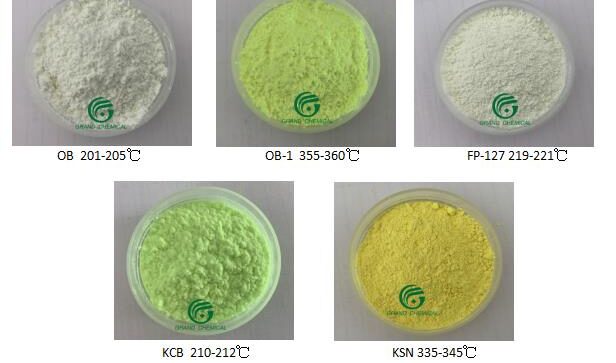
Optical brighteners in plastics are essential functional additives used to enhance the whiteness, brightness, and overall visual quality of plastic products. Even at very low addition levels—often only a few parts per ten thousand—optical brighteners can significantly improve product appearance without altering the polymer’s mechanical properties.
With the growing demand for high-quality plastic products, understanding the correct application methods of optical brighteners is critical for achieving stable, uniform, and cost-effective whitening performance. In industrial practice, the use of optical brighteners in plastics generally falls into three main methods: dry brightening, wet brightening, and masterbatch brightening.
1. Dry Brightening of Optical Brighteners in Plastics
Dry brightening is the most direct and widely used method for applying optical brighteners in plastics. In this process, a measured amount of optical brightener powder is added directly to the plastic resin prior to molding.
Process Description
- The optical brightener powder is dry-mixed with the polymer resin.
- Once the extruder reaches the polymer’s melting temperature, the mixture is fed into the screw.
- During melting and plasticization, the brightener disperses uniformly throughout the polymer melt.
- The material is then granulated or molded via injection or compression processes.
Typical Applications
Dry brightening is commonly used for thermoplastic resins such as:
- Rigid PVC
- Polyethylene (PE)
- Polypropylene (PP)
- ABS and related engineering plastics
Advantages and Limitations
- Advantages: Simple operation, low cost, suitable for large-scale production.
- Limitations: Fine powder can generate dust, leading to environmental pollution and potential handling issues.
2. Wet Brightening of Optical Brighteners in Plastics
Wet brightening is designed to improve dispersion and reduce dust formation during processing. In this method, optical brighteners are introduced in a liquid or slurry form.
Process Description
- The optical brightener is combined with a binder or dispersed in a compatible additive solution.
- This allows the brightener to adhere more effectively to the polymer surface.
- The dispersion is added in controlled batches during processing.
For example, in soft PVC applications, optical brighteners are often pre-dispersed in a plasticizer such as dioctyl phthalate (DOP) at concentrations of around 10% before use.
Typical Applications
- Soft PVC products
- Flexible plastic formulations requiring improved dispersion control
Advantages and Limitations
- Advantages: Reduced dust, improved dispersion uniformity.
- Limitations: The presence of non-volatile organic solvents can cause stickiness, making handling and storage more challenging.
3. Masterbatch Brightening of Optical Brighteners in Plastics
Masterbatch brightening has become one of the most efficient and widely adopted methods for incorporating optical brighteners in plastics.
Process Description
- Optical brighteners are pre-dispersed in a carrier resin to form a concentrated masterbatch.
- The masterbatch is then blended with the base resin at a specified ratio.
- The mixture is processed directly via injection molding, extrusion, or blow molding.
For small production volumes, manual mixing may be sufficient. For larger-scale operations, mechanical mixing is recommended to ensure consistent dispersion prior to molding.
Advantages
- Excellent dispersion consistency
- Clean and dust-free handling
- Precise dosage control
- Suitable for automated, large-scale production
Because of these advantages, masterbatch brightening is increasingly preferred for high-quality plastic products.
Key Precautions When Using Optical Brighteners in Plastics
1. Strict Dosage Control
The addition level of optical brighteners must be carefully controlled. More is not always better—excessive dosage can lead to:
- Yellowing
- Reduced brightness
- Visual defects in finished products
Always follow the manufacturer’s recommended dosage. If application conditions are unclear, technical support should be consulted for formulation guidance.
2. Thorough Mixing Is Critical
Uniform dispersion is essential for optimal whitening performance. Insufficient mixing can cause:
- Uneven brightness
- Streaks or color inconsistency
- Reduced overall effectiveness
Whether using powder, slurry, or masterbatch, thorough mixing must be ensured at every stage of processing.
Conclusion
The effective use of optical brighteners in plastics depends not only on product selection but also on the correct application method. Dry brightening, wet brightening, and masterbatch brightening each offer distinct advantages and limitations, and the optimal approach should be selected based on resin type, processing conditions, and production scale.
By carefully controlling dosage and ensuring thorough dispersion, manufacturers can fully realize the benefits of optical brighteners in plastics—achieving superior whiteness, enhanced visual quality, and improved market competitiveness.
At Shandong Grand Chemical Co., Ltd., we specialize in producing and supplying a wide range of high-performance optical brighteners for plastics, coatings, detergents, and textiles.
📩 Contact us for product data sheets, samples, or technical guidance:
Email: sales@obachemical.com
WhatsApp: +86 13173009832