
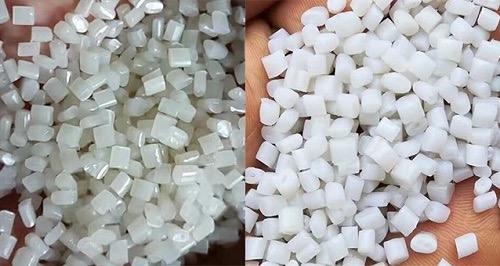
In today’s highly competitive plastics industry, manufacturers face constant pressure to reduce costs while improving product quality. As a result, recycled plastics have become an essential raw material for many processors because they significantly lower production costs—often determining whether a company can remain profitable in a price-sensitive market.
However, while recycled materials offer financial benefits, they also present quality challenges, particularly in aesthetic performance. This is where optical brighteners for recycled plastics play a critical role.
Why Recycled Plastics Need Optical Brighteners
Recycled PE, PP, and other polyolefin granules typically cost several thousand yuan per ton less than virgin materials. But using recycled feedstock introduces two major drawbacks:
1. Poor Whiteness and Dull Appearance
Recycled plastic often contains impurities, aged polymers, and residual pigments, leading to:
- Yellowish tones
- Gray or dull coloration
- A visibly “old” appearance that lowers market value
2. Yellowing During Processing
Repeated thermal history and oxidative degradation cause recycled plastics to yellow when reprocessed, further impacting product quality and consistency.
To solve these issues, manufacturers commonly add whitening, brightening, and optical correction additives, including:
- Optical brighteners (fluorescent whitening agents)
- Titanium dioxide (TiO₂)
- Organic pigments or toners
Among these, optical brighteners offer the most efficient and material-friendly solution because they modify light perception rather than altering polymer composition.
How Optical Brighteners Improve Recycled Plastics
Optical brighteners work by:
- Absorbing ultraviolet (UV) light,
- Emitting blue fluorescence,
- Neutralizing yellowish tones through complementary color correction,
- Delivering a significantly whiter, cleaner visual appearance.
Since they do not chemically affect the polymer backbone, optical brighteners are:
- Highly compatible with recycled materials
- Effective in both injection molding and extrusion
- Cost-efficient for large-scale granulation lines
Manufacturers often compare granules before and after adding optical brighteners—and the results show a striking improvement in color, brightness, and perceived quality.
Choosing the Right Optical Brighteners for Recycled Plastics
There are several commonly used fluorescent whitening agents in the recycled plastics industry. Among the most widely applied are OB-1, FP-127, and OB. Each has distinct performance characteristics, making proper selection essential.
1. Optical Brightener OB-1 — Best High-Temperature Stability
- Decomposition point: Up to 360°C
- Suitable for: PE, PP, PS, ABS, and engineering plastics
- Advantages:
- Excellent thermal stability
- Strong whitening strength
- Very cost-effective for large-scale granulation
OB-1 is the most widely used optical brightener in recycled PE and PP due to its high-temperature resistance and strong whitening efficiency.
2. Optical Brightener FP-127 — High Whiteness, Moderate Stability
- Excellent blue-white tone and bright visual effect
- More suitable for applications with lower processing temperatures
- Commonly used in:
- Underground water pipes
- PVC applications
- General-purpose recycled plastics
Its primary advantage is extremely high whiteness, but its thermal stability is somewhat lower compared to OB-1.
3. Optical Brightener OB — Best for Transparent and Flexible Plastics
- Superior compatibility and lightfastness
- Ideal for:
- Transparent plastics
- Soft PVC
- Transparent PP or PE films
- Benefits:
- Does not cause haze
- Offers excellent gloss and transparency
- Provides good long-term weather resistance
With a favorable price-to-performance ratio, OB is often the preferred solution for flexible or transparent recycled plastics.
Conclusion
The use of optical brighteners for recycled plastics is one of the most effective ways to enhance product appearance, quality stability, and market competitiveness—without significantly increasing production costs.
By selecting the right brightener (OB-1, FP-127, or OB), manufacturers can:
- Improve whiteness and brilliance
- Correct yellowing
- Enhance transparency when required
- Raise the perceived value of recycled products
- Compete more effectively in price-driven markets
As circular economy principles continue to grow, optical brighteners will play a crucial role in enabling high-quality recycled plastic production.
At Shandong Grand Chemical Co., Ltd., we specialize in producing and supplying a wide range of high-performance optical brighteners for plastics, coatings, detergents, and textiles.
📩 Contact us for product data sheets, samples, or technical guidance:
Email: sales@obachemical.com
WhatsApp: +86 13173009832